Q&A: Navigating a Life Through Books: An Interview with Donna Seaman
/
Several years ago, I attended a riveting Chicago Public Library event for Donna Seaman’s groundbreaking book, Identity Unknown: Rediscovering Seven American Women Artists. In person, Seaman exudes a quiet intensity, easily ignited by her many interests, and marked by her quick wit. In the huge auditorium, to a rapt audience, she shared photographs and tales of the seven accomplished artists she had spent years researching.
So when I came across her new memoir, River of Books: A Life in Reading, I knew I had to read it. Seaman is the perfect person to tackle such a project. Over the years, she has worked as a library page, book conservator, bookseller, critic, historian, writer, and literary citizen. She is the Editor in Chief and Adult Books Editor for Booklist, the book review journal published by the American Library Association. A longtime active member of the Chicago literary community, she was involved with the creation of the American Writers Museum and continues to advise on content and programming. She also serves on the Advisory Council for the Chicago Literary Hall of Fame. Seaman is the recipient of several awards, including the Louis Shore Award for excellence in book reviewing, the James Friend Memorial Award for Literary Criticism, and the Studs Terkel Humanities Service Award.
I opened River of Books with some anxiety. If I had to tell my own life story through the books I have read, where would I even begin? Seaman asks herself these same questions, writing “Why would a person read so much? What might all that reading mean?”
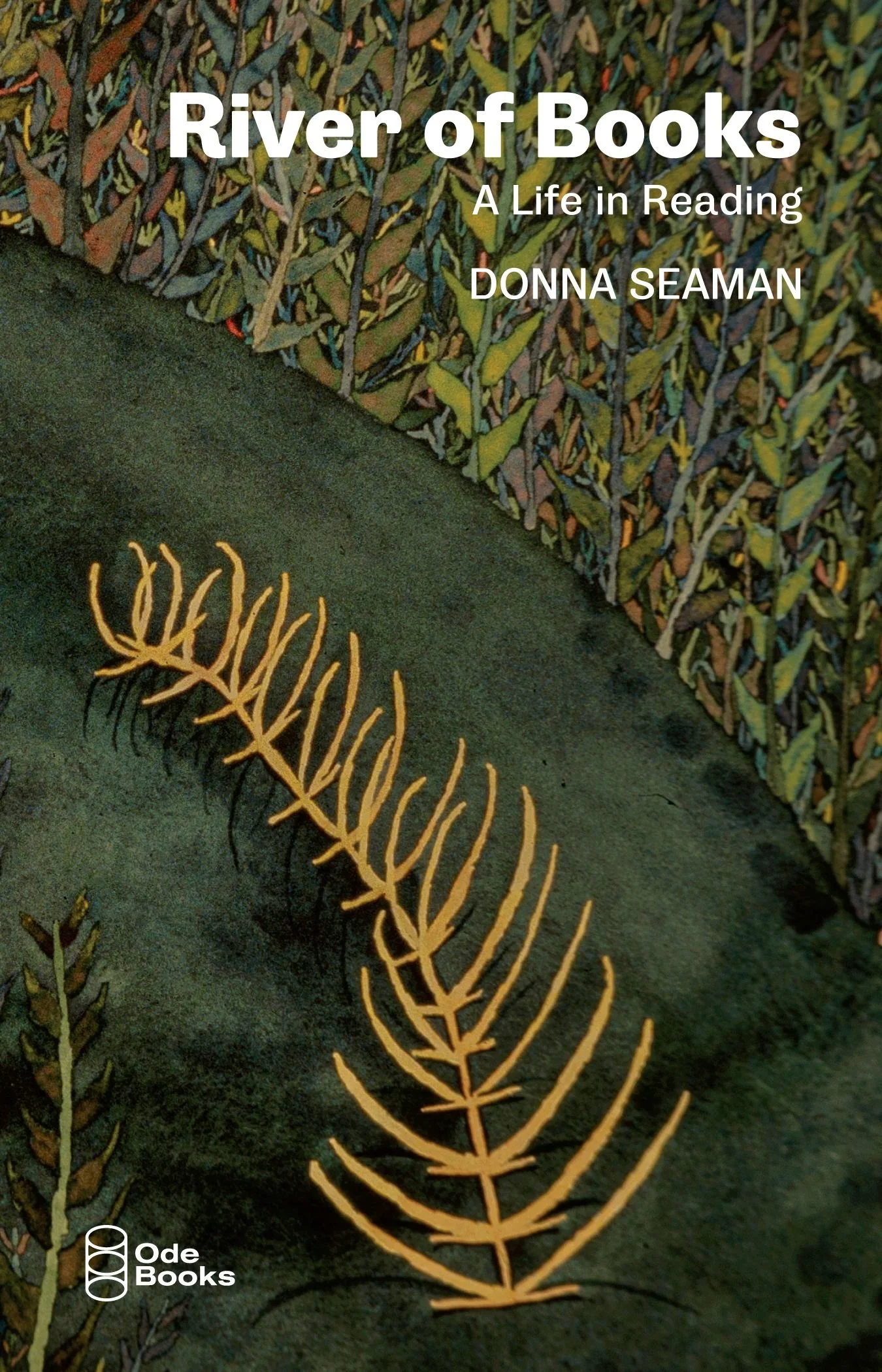
That she manages to answer these questions so thoroughly and eloquently is a marvel. This slim volume of essays moves from childhood to adulthood, from Poughkeepsie to Kansas City to Chicago. The narrative appears straightforward and linear, but Seaman calls on the rivers she has long admired to shape and order her collection. (Indeed, the cover is an image from her series of river paintings.) Each essay flows into the next, coloring and transforming the discoveries to come. “Even a metaphorical river has many ports and portages, tributaries, and coves,” Seaman writes. “I was swept away, spun in whirlpools, hustled by rapids, hurled onto pebbly banks, stuck on sandbars, and snagged in weeds. This look-back has been a retracing and an excavation. An odyssey and a reckoning.”
River of Books is no dry literary critique. The prose is stylish and conversational; the tone moves between exultant and downright funny. For Seaman, books are touchstones, companions, and portals to discovery. Reading is no passive hobby, but a dynamic and subversive act. Many of the books she discusses are classics, and she includes a list of the volumes she mentions at the end of the book. Lifelong readers will appreciate this delightful assemblage of essays, as will those who wish to rekindle their relationship to reading. River of Books leaves us with an irresistible invitation to discover the works that move us, and to dive into the vast literatures that unite us.
Rachel Swearingen interviewed Donna Seaman about the art of writing, reading - and rereading - and that passion that informs her new book River of Books: A Life in Reading (Ode Books) for The National Book Review.
Q. When did you know that you wanted to write a book about books and reading? What was the impetus?
A. Some people were surprised when I wrote Identity Unknown: Rediscovering Seven American Women Artists; they expected me to write about writers. After those profiles of overlooked artists was published, I began to think about turning to forgotten or neglected writers, but instead I found myself writing personal essays for fun, tales about odd or signal moments in my past. I had no real plans for these; I just wanted to write freely. Then Seminary Co-op, Chicago’s not-for-profit bookstore, launched a publishing initiative and came up with the idea for Ode Books, a series of concise books by book people about books and places devoted to books. The famed City Lights bookseller Paul Yamazaki was the first to create a title for Ode Books, Reading the Room: A Bookseller’s Tale. I’m the second. This was the ideal chance for me to combine writing about books with personal stories. I decided to focus on the role books played in my early life, and in my library and bookstore jobs before I joined the staff at Booklist. I was thrilled to have a chance to celebrate the benefits and pleasures of reading and consider how books can help us navigate life.
Q. Your descriptions of books and reading are so sensory-rich that I found myself wanting to grab the largest, most pleasing novel in my collection and hide away for days. Did you learn how to write such beautiful prose through your reading practice? Or has your development as a writer been more deliberate?
A. Thank you so much for saying this! I have to admit that the praise for my writing is a dream come true. I definitely learned to write through reading. I revel in beautiful writing and copy out sentences I’m awed by. I kept journals for many years, writing long descriptions of places and artworks and books along with lots of whining about my failures and difficult relationships. I’ve certainly benefited from the rigor of writing book reviews, especially the painfully concise Booklist reviews, in which every word has to bear weight.
Q. Do you think children today can develop in the way you did without the same relationship to libraries, random encounters with physical books, and long periods of uninterrupted quiet?
A. I share your concern, but I do take heart when I see how many children and young adults regularly go to neighborhood libraries. Libraries are crucial community centers, dynamic and cherished places offering a wealth of materials and services for everyone. I have to hope that kids still find magic in the stacks and illumination on the page. When I speak with younger writers, they’re full of memories of childhood hours in libraries and of inspiring, helpful librarians. Their experiences mirror mine even as the digital imperative has intensified.
Books do have more competition than ever, and I do worry about how our devices with their slick, swipeable screens and all the quick takes on social media atrophy attention spans. Reading does require sustained spells of concentration and a willingness to step away from all the clamor and flash and immerse yourself in a world made of words. Given the chance, many kids will savor these interludes and acquire the reading habit. Kids do still fall in love with books. We just have to be sure they acquire the skills they need to enjoy and crave reading. I worry most about inadequate education and low literacy.
Q: You write about losing your sister, a poet, when you were both in your twenties. I understand that you established awards for young writers in her memory. Can you share more about this?

A. Thank you for asking about the Claudia Ann Seaman Awards for Young Writers. Claudia’s death was such a shock. I had just completed graduate school. Claudia was a very promising poet; she started writing poems in high school. I thought a fitting way to honor her and let young writers know that their efforts are valued would be to establish an award for high school poets. Initially the contest was open to teens in the Mid-Hudson Valley, where we grew up. The fund is managed by a not-for-profit organization, Community Foundations of the Hudson Valley. (Donations can be made by visiting the Claudia Ann Seaman Awards page.)
The staff helped with outreach to area high schools, while, at first, I served as the sole judge. Each spring I received what I called the box of angst—hundreds of poems penned, typed, or printed by teens. Many were raw cries from the heart, which I hoped were cathartic. But amidst the emotional outpourings, there were always a handful of genuine poems, poems written with skill, perception, and wit, stellar works for any age poet.
At some point, since I lived in Chicago, and, thanks to Booklist and my radio show, I had access to writers, I decided to make the award national in scope and invite published poets to serve as judges. I still read all the submissions, but then I winnowed them down to a pool of finalists from which the poet judges selected the winners and honorable mentions. Claudia’s award took on even greater impact once I became involved with Polyphony Lit, an ingenious literary magazine for high school students. Not only is this a publication to which teens can submit their writing, it is also a venue for young adults to learn how to evaluate the work of their peers and give feedback as well as how to edit and put together a magazine. The brain child of Chicago writer Billy Lombardo, Polyphony Lit became the home for the Claudia Ann Seaman Awards for Young Writers and we now have awards for poetry, fiction, and creative nonfiction. Each year, writers serve as judges for each award. Remarkably generous and enthusiastic judges, including, most recently, Lydia Millet, Nicole Chung, and Diego Báez. We receive submissions from all around the world, and each year the judges marvel at the high quality and depth of the submissions. It’s deeply reassuring to know that young people love literature and feel inspired to join in the grand and transcendent conversation as readers, writers, and editors.
Q. “Blue River, A Tributary” focuses on your college years, studying art in Kansas City, a time when you turned to reading as a cure for the “abrading demands of everyday life.” Is reading still the antidote today that it was then? Is there a book you might prescribe to someone who is having an especially difficult time with the state of the world today?
A. Reading is absolutely the antidote now as it has long been for me. I need to spend some time reading every day to feel well and centered. My first impulse is always to read, no matter what work or chores need to be done.
As for prescribing a book for someone struggling with the state of the world, I would recommend artistically written books that celebrate beauty and wonder. Many people avoid, perhaps even fear poetry, but poetry recalibrates your mind in deeply nourishing ways. I think most readers would find solace and wonder in the poems of Mary Oliver. Jane Hirshfield is another poet whose poems lower one’s anxiety. Classic nature writing—Rachel Carson’s books about the ocean, Annie Dillard’s Pilgrim at Tinker’s Creek, Diane Ackerman’s A Natural History of the Senses--evoke wonder in the living world’s miracles. To read John McPhee is to dwell in well-chosen facts, uplifting clarity, and supreme true storytelling. Fiction is transporting and reconnects us to timeless truths about humankind, offering a deep perspective. Reading novels and stories by Virginia Woolf, Flannery O’Connor, Toni Morrison, Marilynne Robinson, Andrea Barrett, Zadie Smith, Michael Chabon, Alice McDermott, Claire Messud, Richard Powers, Jhumpa Lahiri, Bonnie Jo Campbell—works of literary splendor and profound insights—evokes a great spectrum of feelings and recognitions and maps a way out of gloom.
Q. Many of the books you describe are connected to a particular time and place in your life. It’s so true that a book is never, as you say, the same book. Is there a beloved book that you’ve read again, only to find that it had changed for you?
A. When I reread Nobel laureate Gabriel García Márquez’s profoundly influential masterpiece, One Hundred Years of Solitude, many years and many books later, I was struck by scenes I remembered and scenes I did not. The same with the extensive cast of characters and the grand array of wonders and sorrows that besiege the impassioned Buendía family in Macondo. I was so astonished and at sea the first time through; I missed many subtleties and much of the deeper history and dimensions, the complexity of spirit and desire, invasion and resistance, madness and transcendence. Of course, there was so much I didn’t know about the world, and devoted as I was to reading, I didn’t yet fully appreciate all that novels can do. Most likely I still don’t! Novels still send me into a whirl. One thing I can say for sure is that One Hundred Years of Solitude is a novel everyone should read, and then read again.
Q. I was heartened to find that Bette Howland’s wonderful short story “Public Facilities” had as much of an effect on you as it did on me. Her writing is incredible, her depictions of people and neighborhoods so sharply observed and brilliant. I first learned of Howland through the Chicago Literary Hall of Fame, an organization you have served in a number of ways, most recently as an advisory council member. Could you tell us more about CLHOF?
A. High praise to Don Evans for founding the Chicago Literary Hall of Fame, a not-for-profit organization with a terrific online presence. It’s remarkable what Don has achieved with so few resources: building a website rich in literary history; creating a thoughtful induction process for adding writers to the line-up, including the keen and arresting Bette Howland; bringing Chicago literati onboard to nominate and choose writers; founding awards to honor established authors and young writers just starting out. The hall of fame crew is so inventive and passionate, organizing all kinds of literary events to explore Chicago’s literary history and celebrate current writers. I encourage everyone to visit the website and learn about all that this not-for-profit venture does to recognize, honor, and share Chicago’s superlative literary history and current literary community.
I would also recommend visiting the American Writers Museum. This innovative museum chose Chicago as its home because of the legacy and vibrancy the Chicago Literary Hall of Fame pays tribute to. But the museum illuminates all of American letters in its exhibits and its continual roster of events live and virtual. This is run by another small group of dedicated and creative individuals finding many ways to engage people with books and writers.
Q. You were such an insatiable reader as a child. Do you have any advice for parents who would like to see their children read more?
A. As so many people more knowledgeable about children than I am always say, read to your children! Read to them every day and every night, read with enthusiasm and delight. Give your children books, a home full of books is a home full of imagination and possibility, mindfulness and curiosity. My parents were strict about when and how much television we could watch, which certainly encouraged my reading and writing, drawing and playing. It’s much more complicated and challenging now, with the explosion of devices and the internet, but setting limits on screen time does open up space for reading and daydreaming, writing and being creative in other ways while staying off the grid.
Q. Do you have a guilty reading pleasure? A book that you return to for pure joy or entertainment?
A. The only guilt I feel regarding books are those I’m not able to read or assign for Booklist for one reason or another. Those haunt me. As for books I find myself rereading with pleasure, there’s The House on Mango Street by Sandra Cisneros, a gem of a book. And The Little Prince, a lifelong favorite.
Q. What is your home library like? How do you organize your books? What are some of your most prized books in your collection?
A. This makes me laugh and groan. My home library is chaos! It’s shameful. I have too many books and not enough shelves or rooms. There are bookcases everywhere in this small house and stacks of books on the floor in my writing room /office. It’s a terrible mess. I prize many books. So many! All the signed books I’ve acquired by interviewing so many authors. My most recent signed treasures are by Gabrielle Zevin, Rachel Kushner, and Jean Hanff Korelitz. I also treasure childhood books, and books that were given to me, including a beautiful copy of Mrs. Dalloway, Lord Jim, The Sea Around Us, The Complete Works of Isaac Babel, Housekeeping. I also treasure my copies of The Recognitions, The Franchiser, Gravity’s Rainbow, and Divine Days. I could go on.
Q. Do you still follow a reading plan? Do you have advice for readers who want to expand their tastes and read more?
A. I read constantly for Booklist and to prepare for author interviews and other projects. I live and read in accord with the magazine’s production schedule and my events calendar. As for readers who don’t read on deadline and who want to read more adventurously, I suggest browsing in libraries and bookstores. Read reviews. With nonfiction, and I strongly recommend reading a mix of nonfiction and fiction, read about what interests you: particular times in history, particular places, some aspect of nature—animals, plants, rivers, the stars. Read biographies and memoirs about or by people you’re intrigued with. For fiction, awards can be helpful guides. The Carnegie Medals, National Book Award, Booker, National Book Critics Circle all release longlists each year that offer lots of potential great reads. Public libraries recommend books on their websites. Keep a list of books that you hear about and work your way through it. A lot of people listen to audiobooks. It can be difficult to find long stretches of time in which to read. Listening can be done while commuting, walking, working out, cooking and cleaning.
Q. You’ve interviewed so many authors yourself over the years. Could you tell us about one or two you most enjoyed that we might be able to find?
A. Every conversation has been enlightening and enjoyable, surprising and challenging. The Chicago Public Library has many interviews on their You Tube channel, including my conversations with Lorrie Moore and Silvia Morena-Garcia and One Book, One Chicago authors, including Elizabeth Kolbert, Tommy Orange, and Gabrielle Zevin. The Chicago Literary Hall of Fame has an interview with Sandra Cisneros. I also have some links on my website: donnaseaman.com. I’m so grateful for all the opportunities to speak with brilliant writers. My most recent event as of this writing was at the Miami Book Fair where I was in conversation with Jean Hanff Korelitz and Rachel Kushner.
Q. A number of years ago it hit me that I would never be able to read many of the books on my list. Some I’ve been meaning to read for decades. Are there unread books that haunt you?
A. Yes, many! As much as I read, there are always books I’ve missed. And there are many books I long to reread. I would start with Toni Morrison.
Q. You mention a love of books that blend art and science. Could you recommend one?
A. There are so many! Books by exceptional nature and environmental writers, from Henry David Thoreau to Rachel Carson, Barry Lopez, Terry Tempest Williams, Gretel Ehrlich, and Lydia Millet all qualify by combining beautiful writing with scientific fact. For a unique approach, I suggest Figuring by Maria Popova.
Q. Many of your descriptions show a deep appreciation of books as material objects. You even worked for a spell in conservation at the Newberry Library, rebinding and covering books. How have you navigated the move to online reading?
A. The COVID-19 lockdowns made digital reading a necessity for work. We always had print galleys at Booklist and I’ve always read and treasured physical books. But when we started working remotely, we had to change all our procedures and adapt to reading e-galleys. At first I had a hard time. I was so used the geography of books, the two-page spread, the obvious progress through a paper galley, the ease of marking pages. I found the screen slippery and the text lacking landmarks. But I soon set all that aside and found some advantages to what I called “invisible” books. I have so little space, it’s a boon to be able to have entire libraries on a device. I especially appreciate this when I travel. I like being able to adjust the font size. I continue to take notes with pen and paper and there are ways to mark up passages on e-galleys. And digital proofs do save paper.
Q. Are you working on a new project now? Could you tell us a little about it?
A. We cut a lot of pages from the manuscript for River of Books, including a long section about the professor who influenced me the most in grad school and the heady experience of finally reading his novels. I hope to turn that into an essay. My other plans include writing the type of profiles I wrote for Identity Unknown, this time portraying hidden but crucial behind-the-scenes book people, including book review editors.
Rachel Swearingen is the author of the story collection How to Walk on Water and Other Stories. Her stories, essays, reviews, and interviews have appeared in Electric Lit, Off Assignment, The Missouri Review, Kenyon Review, American Short Fiction, and elsewhere. She lives in Chicago.