Q&A: Jane S. Smith on Her Public-School-Teacher Father's McCarthy Era Story
/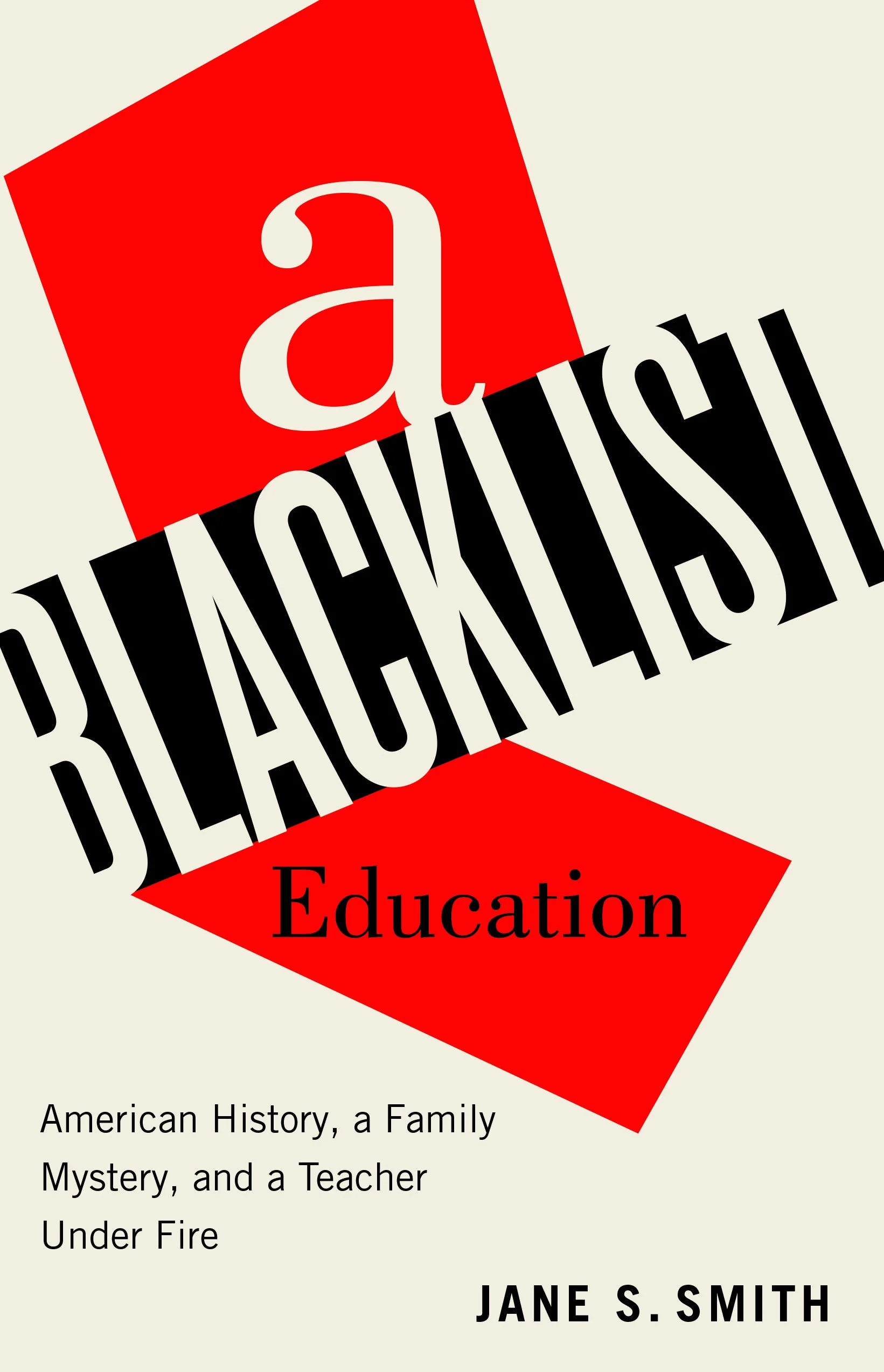
Jane S. Smith’s A Blacklist Education: American History, A Family Mystery, and a Teacher Under Fire (Rutgers University Press) is an engrossing personal account of the McCarthy-era purges that goes beyond her father’s experience in the New York City public school system and extends to classrooms across the nation.
The author of acclaimed works on science and society—including The Garden of Invention: Luther Burbank and the Business of Breeding Plants, winner of the Caroline Bancroft History Prize, and Los Angeles Times Book Prize winner Patenting the Sun: Polio and the Salk Vaccine—Smith turns her eye to her own family, when she was at “the cusp of retained memory” and her father was brought down in the Red Scare.
Uncovering the twentieth-century story of teacher blacklists nationally was, she writes, “an education in sympathy and outrage.” She also came to understand that her father, Saul Schur, son of Jewish immigrants, a union member and a devoted teacher at the Samuel Gompers Vocational High School, part of New York City’s public education system, was a victim of the national effort purge liberal and left-leaning teachers from classrooms. “He was taken down as brutally as any victim of schoolyard bullies,” his daughter now writes.
An elegant. eloquent personal narrative that only Smith could write, A Blacklist Education unspools like a mystery with the nuance of great social history. It is also the story of disillusionment. “Raised to revere the power of education and … democratic equality,” Smith writes, Saul Schur did not just lose his job; “he was robbed of his ideals.” Smith reflected on this period of history and her father’s place in it for The National Book Review.
Q: Your opening sentence in A Blacklist Education is brilliant! When did it come to you the writing process?
A: “The year I entered kindergarten, my father got kicked out of school.” That came to me very early on, though it took a couple of brilliant early readers to nag me to make it the opening sentence. It struck me right away that my entry on the path of education overlapped with my father’s reluctant exit from his teaching career. The opening sets the tone, which is often informal and very personal, and it also establishes that this is the story of a double education, his into the realities of the blacklists and mine into a historical event that shaped my world before I was old enough to know about it.
Q: Your earlier books required quite a bit of research. How did the collection of evidence differ with A Blacklist Education?
A: There was a LOT of research behind this book, although the text is under 200 pages. Usually, though, I know in advance what I’m looking for. In this case, I had a heap of bewildering documents that led me to a program I had never heard of and took me down all sorts of archival rabbit holes before I really understood what my little pile of papers and photos showed.
Q: Many who have endured the ordeal of sorting though their family papers imagine coming upon a document that will unlock the door to family mysteries. How did that work for you?
A: I am newly convinced of the power of chance and coincidence. If I hadn’t read a newspaper story that mentioned the archive where the records for these Cold War teacher purges were held, and if the archivist hadn’t replied to my random email and said, yes, your father was a suspect and it’s in our files, there would have been no book. After that came lots of dogged work, but that was the beginning.
I was also lucky in knowing enough about research to have saved unique documents, like personal letters and hand-written tax notes, even if I didn’t quite know why. Never throw away your family history!
Q: Might you set the stage for this tragic drama? Can you introduce your father, and evoke the world of your family and its values?
A: Both my father and mother were children of immigrants who had arrived in this country with few resources and less English. School was really a transformative adventure for my parents, a chance to master skills and information that could catapult them to academic and professional heights my grandparents could never have achieved. Native-born citizens of the United States, my parents also assumed they were entitled to the cultural heritage they learned in school, from American history and literature to a taste for early American furniture and architecture. The charge of being “un-American” was a painful assault on the patriotic identity nurtured in the very schools that now turned against my father. But they never lost their deep respect for education.
Q: Why do you think your father was targeted?
A: There are so many possibilities, though no certainty. He had been marked as a troublemaker early in his career, when he and other teachers reported their principal for padding his payroll and another school administrator for abusive anti-Semitic, racist, anti-Italian behavior. He had written letters objecting to teachers fired for exercising their right to free speech, which landed him on a secret police list of “subversives.” During the 1950s investigations, the only way to prove your true loyalty was to “name names,” so he was accused of communist sympathies by other teachers desperate to keep their jobs. There is no evidence that any of it was true, but that didn’t matter.
Q: Why has this episode been so overlooked by historians?
A: There are histories of the teacher purges, very good ones, but they don’t really focus on the individuals and don’t have a general readership. Many famous people were caught up in the post-World War II red scare, from scientists like J. Robert Oppenheimer to Hollywood stars, and celebrities draw most of the attention, then and now. The blacklisted teachers were very ordinary people. They had no access to atomic secrets, no glamorous romances or Academy Awards. Even their names were hardly ever known. That is the story I wanted to tell, what this kind of daily, terrifying repression feels like to unimportant individuals on the ground. That’s another reason I included so many of my own very early memories, to show the family life that is backdrop to headline events. Also, many of those memories are funny and sweet, which we all need.
Q: The loss of idealism was such a poignant theme in your account. Did you anticipate that when you embarked on the book?
A: No, not at all. I was amazed to see what an active citizen my father had been, both as a teacher and as a parent fighting for new schools in his very overcrowded community. Seeing his early idealism made me re-evaluate the resigned skepticism I had thought was a central part of my father’s personality. He never stopped supporting programs he believed in, but his defeats had tempered his youthful optimism. He became more savvy but also less convinced of the power of doing the right thing.
Q: You recently wrote a wonderful essay about Good Night, And Good Luck, which is about journalist Edward R. Murrow’s battle in the 1950s against smear campaigns of false accusations used to fire people from government, military, the arts, and education. Are contemporary connections inevitable?
A: Not inevitable, but right now very real. So much of our current political scene looks like an effort to return to the 1950s, which was an era of prosperity but also a time of conspiracy theories, paralyzing epidemics, toxic pollution, overt racial and sexual discrimination—and teacher blacklists. When the state of Oklahoma tries to institute special ideological tests for teachers who formerly lived in California or New York, on the grounds that they might be tainted with dangerously liberal ideas, it is easy to see the parallels. The pattern of baseless accusations, grandstanding politicians and helpless victims, both teachers and students, has returned.
Q. Back to the research and writing of this book. How did it change you?
A: So many ways! It’s usually a bad idea for non-fiction writers to talk about their research methods in their books or include themselves as characters, but this really is a detective story, and I became the sleuth. I had to include my search for clues and my own leaps of association, so that was a change for me as a writer.
It changed me as a person, too. A Blacklist Education reveals a sad and sometimes shocking story, but I took hope from the knowledge that the abuses of the 1950s led to many of the reforms of the following decades. At a time when many in power are trying to erase history, it’s easy to get discouraged. By uncovering hidden truths and forgotten acts of resistance, I felt I was actively pushing back against efforts to deny the real complexity of the past.