Q&A: Kurt Baumeister on Trump Craziness, Norse Myths, and His Novel 'Twilight of the Gods'
/Why does the author Kurt Baumeister seem to know what’s going to come before we do? In his savvy first novel Pax Americana (Stalking Horse Press, 2017) Baumeister explored the impact and confluence of new technologies, including AI before it was something we found ourselves talking about all the time. In his rollicking new novel Twilight of the Gods (Stalking Horse Press, 2025) Baumeister does a deep dive into modern fascism through the lens of Norse mythology. Would it surprise you to learn that these are fun reads, while also having their finger on the pulse of our contemporary world? "That would make sense, as it would be to discover that Baumeister is as cynical as they come," notes Ben Tanzer. "It’s just that he’s not. Instead, he’s full of hope." Tanzer led this conversation about politics, mythology, the world of corporate finance and, of course, writing fiction with Baumeister for The National Book Review.
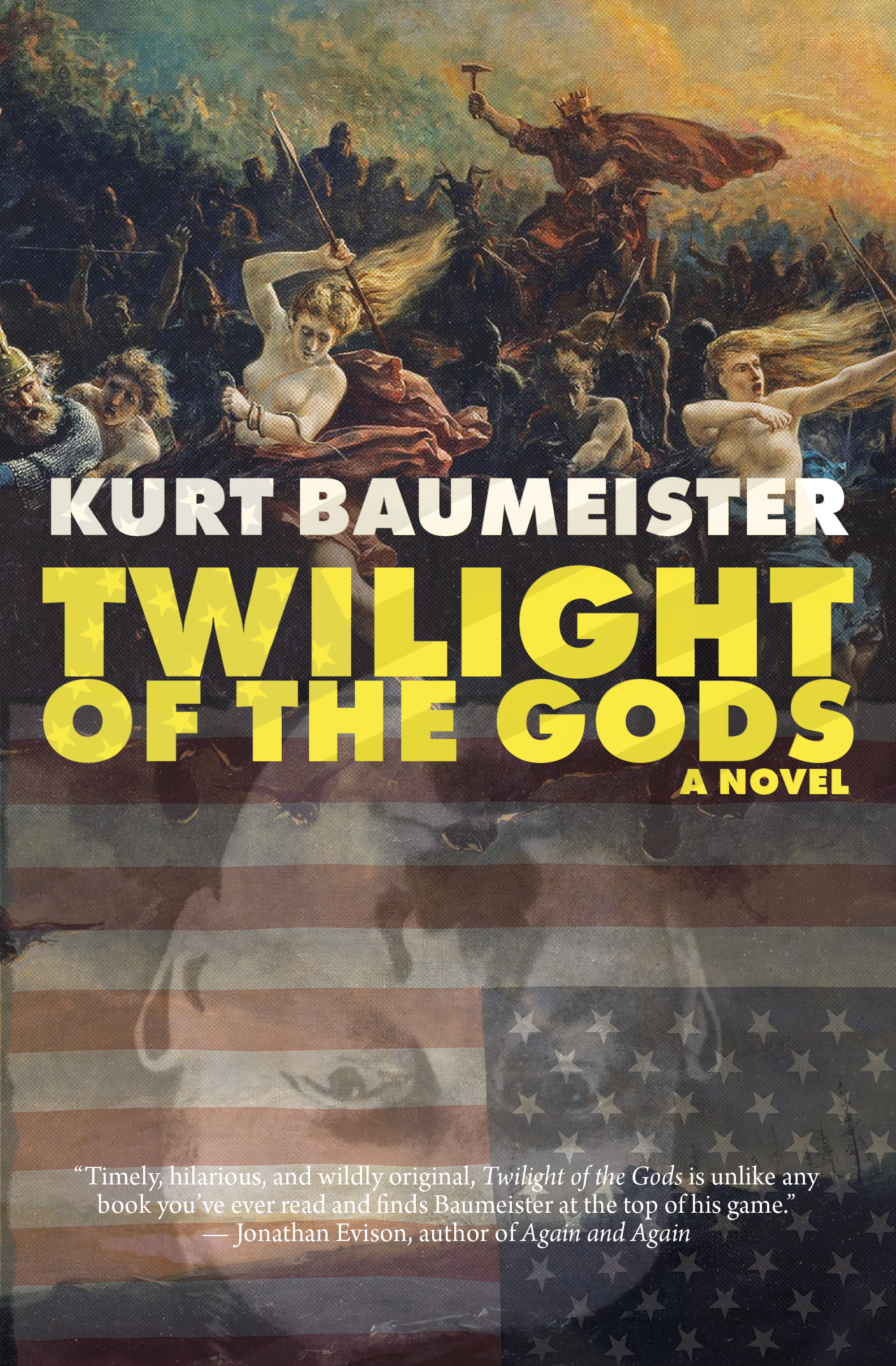
Q: I'm struck by how timely Twilight of the Gods feels in terms of our current politics and culture and yet, this isn't a book you just wrote, the idea was germinating for a while. Can you speak to the headspace you were in that allowed you to tap into this epoch we find ourselves in now?
A: Like a lot of Americans, I’ve spent the last decade dealing with one Trump generated national embarrassment after the next: hectoring President Obama about his birth certificate, the escalator and Mexico’s “rapists and (some) good people,” the Great Wall of Trump, his “stable genius,” destroying the UN, destroying NATO, his endless praise for Vladimir Putin and any other authoritarian who’s made the requisite donation of money or obeisance and/or holds the equivalent in kompromat, his “best people” who all turn out to be abject idiots even by Trump’s own standards, the Muslim ban, shooting bleach, faith healing, “Proud Boys stand back and stand by,” upside down Bibles, inciting a riot at the Capitol, threatening judges, threatening politicians, threatening citizens, tariffs, more, worse tariffs, threatening the Fed, threatening Europe, threatening Mexico, threatening Canada, threatening Greenland. He does a lot of threatening, doesn’t he?
Thinking about it, I guess maybe Twilight of the Gods is my response to all Trump’s accumulated threats, both fight and flight. When I was working on this novel, I could escape in a way. I could retreat into a world filled with history, myth, and magic, a world in which America was still the heroic nation I’d grown up believing in. Now that I can see the output and set it against the reality we’re living through, I think that output, this novel, is my way of fighting, of speaking to and about the reality of the time we’re living through.
Q: Let’s talk craft, and how you determined the best means to unpack and make sense of the chaos we’re experiencing was drawing on the mythology of the Norse gods to tell this story?
A: The through-line is the idea of absolutism and the uses we put it to whether that’s political, religious, or maybe even personal absolutism. The first two are obvious, but what’s personal absolutism, you’re probably asking? Maybe it’s the reality of a cult of personality like the one Trump’s developed, the primacy of his persona and ego taken to the extreme at which his followers completely suspend reason and choose to believe in the figure at the center of the cult, even though what he says makes no sense.
My use of a pantheon of fallen gods no one believes in as the main culprits in humanity falling to fascism again and again, is a way of deconstructing the uses we put absolutism to, a way of asking why we keep coming back to it in its many different forms: fundamentalist Christianity or Islam, fascism, communism? Is the world just too scary for us, scary enough that we can’t take it as a species? Is that why the 20th and 21st centuries have seen the rise of so many forms of absolutism? Are the problems we face so great that we simply can’t deal, that we have to fall back on “God said” or “Dear Leader said” in order to navigate reality?
Q: Your books are biting and provocative, challenging the reader to look at themselves, the country, and the roles we play and do not play in the state of things. Do you think about what impact your books will have on the reading public or what impact you hope they’ll have?
A: Thanks, that’s nice of you to say. Like most writers, I do think about that. You write books with the hope they’ll be read by a lot of people—hundreds of thousands, millions. But the reality most of us come to—those of us who actually publish books which is a tiny percentage of all writers—is that in spite of our best efforts, our books aren’t going to be read by hundreds of thousands of people. They’re going to be read by hundreds or thousands of people, at most. Sure, this is a comedown, but it does bring you back to an assessment of why you wrote your book in the first place.
I think we write for ourselves first, before anyone else. We write to communicate with ourselves, to crystallize how we think and feel, what we have, or haven’t, figured out about our realities. Yes, of course, we’re also trying to communicate with others, once we’ve at least sort of figured out what we’re saying, but without the primary impulse of making sense of what we see to ourselves, what point would there be?
Q: : Please talk about your background, the work you’ve done, your upbringing, and education, and how these things have influenced the engaging mix of politics, humor, and rage, as well as the unique voice you bring to your writing.
A: I worked in corporate finance for about fifteen years, different aspects of it from accounting and financial reporting to financial analysis and modeling, tax, and strategic planning. There was a certain comfort to it, of belonging in a way, of getting paid. But despite being good at math and finding the work relatively easy, I was never very happy in the corporate world: There were too many meetings, too many people telling me what to do and when they wanted me to do it. I eventually got fed up and left the corporate world. I’d been able to make some money investing in stocks and real estate, so I was able to make it work.
Politics have always interested me probably because I’ve always found history so interesting and politics have always seemed to me as the motives behind history. I feel you have to try to keep your sense of humor in spite of what’s going on, whatever that is; but humor and rage aren’t always so different. I suppose humor is rage controlled in a way, muted, turned into something positive.
As far as my writing voice is concerned: I’ve always felt more comfortable writing than speaking or even existing in the world at large, so I would say my voice is something I’ve always had on some level, a certain comfort being myself while writing that I don’t feel at other times. I’ve refined my voice over the years by reading writers like Amis and Nabokov, DeLillo and Vonnegut, Kundera, Rushdie, Michael Moorcock, and so many others.
Q: There are numerous characters, timelines, and locations in this book, and I’m interested in what sort of research you do, if you outline, and how a Baumeister book takes shape?
A: I’ve tried outlining. Sometimes it’s helpful once I get to a point at which I’m stuck, but I’ve never been effective at making an outline to start with then sticking to it. My thoughts and my writing process are just too chaotic for that.
I tend to write what I know and/or what I think I can plausibly make up. I’ve joked about this issue at events, about how I just sort of “make shit up” when I need to, but I always want those inventions to at least sound plausible. When I get stuck, I think back to science fiction and fantasy, the plausible ways in which magic and fictional science get explained. It’s about finding the right words to hint at what you’re going for, about coming up with something that sounds like an explanation rather than an actual explanation. My first novel, for example, Pax Americana, was about a confluence of current technologies (AI, virtual reality, neural interfacing) and how they might come together. I don’t understand any of those technologies at the level you’d have to in order to actually work on developing them, but I know enough to make a reader wonder if something’s possible.
Twilight of the Gods is about contemporary politics, the last century of world history, and Norse mythology, three things I already know a bit about since I’ve been interested in them most of my life. I suppose the last thing this book is about, in a weird way, is me. As I was writing this, I began to wonder how many books I have left to write. I’ve always wanted to put myself in my fiction, as a character, and, so, this book became a memoir to some extent. You can find pieces of me in the main character and narrator, Loki, the lesser character, Kurt, and the implied (and/or real) author, Kurt Baumeister.
Q: You occupy an interesting place in the world of indie literature, you write acclaimed books, you work with a respected publisher (7.13 Books), you interview authors and write reviews, and I’m wondering from where you sit what your take is on the world of publishing these days?
A: Thanks for all the kind words. Fortunately, in the writing world, it’s hard to let anything go to your head for long. So, let’s see: To me, the literary world is a place of magic and commerce, luck and science, wonderful people and more than a few raging narcissists. I mean it though: there are a lot of highs and a lot of lows. The greatest change I see on the horizon is the continuing impact of AI. I feel like the literary AI debate is of a piece with the same technology debate we’ve been having for a long time.
When I was in grad school there were people trying to wreck e-books, people desperate to live in the world they’d imagined as a child, the world in which books were discrete objects, not simply compilations of text. Sometimes they sounded like they respected the artifact more than the text it contained. They’re both things, of course, but if you had to choose, you’d be foolish not to come down on the side of a book being text before anything else. Yes, the pages smell a certain way, and the cover feels a certain way. Leather bindings, gilded pages, deckled edges: All those things are great and snazzy, but they’re not the core of what a book is, which is text. As far as AI goes, I think humanity is going to put it to the uses it wants to, regardless of what people in different fields think. Accountants won’t be happy when it’s applied to accounting; lawyers won’t be happy when it’s applied to law; and writers won’t be happy when it’s applied to writing. Am I happy about the prospect of AI being able to write better novels than me? Of course not. But I feel like getting too exercised about it is pointless, like trying to hold back the tide with your bare hands.
Q: The easy final question would be to ask you what’s next for you, but given your gift of literary prognostication, I’m more interested in asking what’s to come, everywhere, and for all of us.
A: I have a book of short stories I recently lost a landing spot for, so there’s that. I’m working on my next novel, As Below, So Above, which I’m calling a murder mystery set in Hell, though it’s a Hell that for most purposes looks a lot like America. I’ve also been writing a proper memoir, trying to come to terms with how crazy my world has been the last several years.
In terms of what’s next for Americans or humans, or whatever: Based on what I know at the moment, I don’t think it’s pretty, but I also think technology will surprise us, quite possibly save us. We’ll probably figure out ways to slow and adapt to climate change. We’ll probably figure out ways to make nuclear weapons obsolete. We’ll probably figure out ways to harness renewable energy much more efficiently. AI will help with all these things as long as we can keep it working for us, rather than beyond or against us. The challenge, as always, will be the unforeseen negative impacts of whatever technologies we develop. Perhaps AI will be better at looking ahead than we are? Perhaps it will allow us to leap over problematic intermediate steps. Would AI, for example, have had us going through all our different stages of using combustion technology, first with wood, then with all the various fossil fuels? How would the climate look if we’d been able to skirt the use of coal and/or oil?
Barring any major fixes, I see mass migration from south to north, the world becoming even more polarized along the lines of religion and race. I think that Asia is particularly in for a tough time. When I look at East Asia, I see the same sort of concentration of power that spawned two world wars in Europe. You have many of the world’s major powers in geographic proximity to each other, powers like China, India, Russia, Japan, Pakistan, and the Koreas. These nations are going to struggle over arable land, food and water supplies, all sorts of other resources, never mind political and religious disagreements.
I think America is still fortunate in terms of geography, at least in terms of actual occupation by enemies; we have oceans protecting us on either side, the world’s most powerful air force and the world’s most powerful navy. But time will tell. We’ll experience a lot of south to north migration here, too. Obviously, parts of America will be affected greatly by climate change, assuming we don’t develop better technologies to help us deal with that. As dour as this might sound, I do have hope for us and the world. Without hope, what’s the point?
Emmy-award winner Ben Tanzer's acclaimed work includes the short story collection Upstate, the science fiction novel Orphans and the essay collections Lost in Space and Be Cool. His recent novel The Missing was released in March 2024 by 7.13 Books and was a Chicago Writers Association Book of the Year finalist in the category of Traditional Fiction and his new book After Hours: Scorsese, Grief and the Grammar of Cinema, was called by Kirkus Reviews: "A heartfelt if overstuffed tribute to the author’s father and the ameliorative power of art," was released by Ig Publishing in May 2025. Ben lives in Chicago with his family.